

Otoplasty (ear correction)
Correction of ear shape or projection for a position closer to the head and more balanced proportions.
What the Procedure Is
Otoplasty is the surgical procedure that corrects the appearance of prominent ears, by reshaping and repositioning the auricle.
Prominent ears may have several causes, which can occur separately or together:
- absence of the natural fold of the ear cartilage (antihelix);
- excessive development or an overly forward position of the cartilage in the central area of the ear (concha);
- an ear lobe that projects too far outwards.
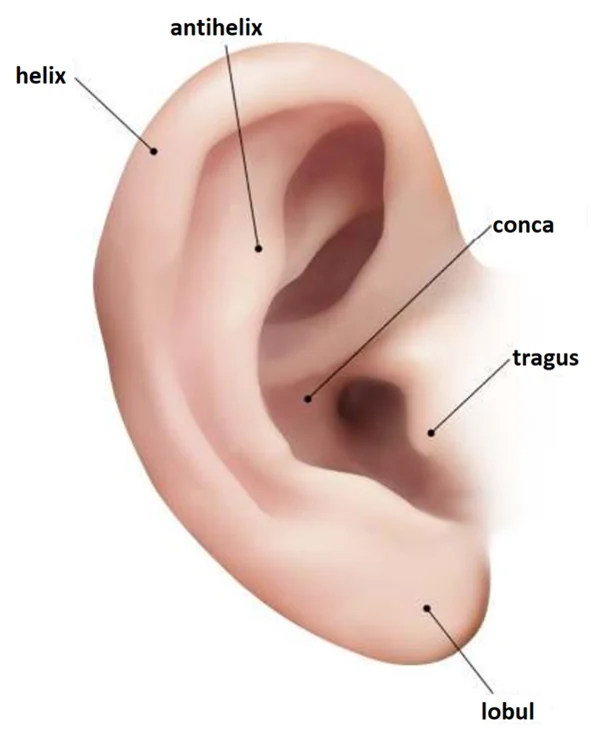
The aim of the procedure is to obtain ears with a natural, harmonious appearance, close to the head, symmetrical and adapted to the features of the patient.
Otoplasty may be performed on one or both ears, according to need. The procedure can be carried out in adults as well as in adolescents or children, usually after the age of about 7, when the child is aware of the problem and expresses a wish to have it corrected.
In children and adolescents, the procedure can bring an important benefit to psychological comfort, helping to reduce the distress caused by comments or teasing and to improve self-confidence.
Who It May Suit
It may be performed in adults and, after careful assessment, in children whose ears are sufficiently developed and who have clear personal motivation.
What It Can and Cannot Address
It can improve ear shape and position but does not pursue absolute symmetry and does not alter hearing.
How the Consultation Works
Before the procedure
During the pre-operative consultation, the surgeon will assess:
- the shape and position of the ears;
- the degree of prominence;
- any asymmetries;
- the quality of the skin and cartilage;
- medical photographs to document the case.
Depending on the situation, blood tests may be recommended to assess the risk of bleeding.
If the procedure is carried out under sedation or general anaesthesia, you will have a pre-anaesthetic consultation.
Recommendations before the operation
- Avoid smoking for at least 4 weeks before the procedure.
- Do not take medication containing aspirin or non-steroidal anti-inflammatory drugs (e.g. ibuprofen, diclofenac) for approximately 14 days before the operation, as they may increase the risk of bleeding.
- On the day of the operation:
- If sedation or general anaesthesia is used, you must not eat or drink for approximately 6 hours before the procedure.
Smoking and healing
Smoking affects blood circulation and may increase the risk of:
- delayed healing;
- infections;
- skin problems;
- complications related to anaesthesia.
Complete cessation of smoking is recommended at least one month before the operation, continuing until healing is complete.
The same recommendation applies to electronic cigarettes.
How the Procedure Is Performed
The operative technique is adapted to each patient.
The incisions
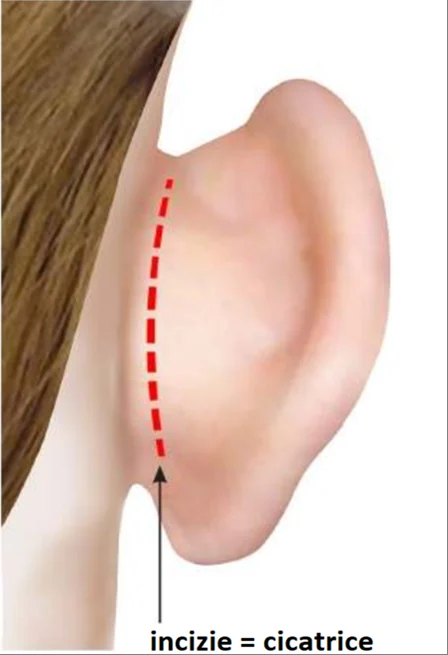
The incision is usually made in the natural fold behind the ear, so that the scar is as inconspicuous as possible.
In some cases small additional incisions may be necessary, hidden in the natural folds of the ear.
The hair is not cut during the operation.
Reshaping the cartilage
The ear cartilage is reshaped to correct the existing deformity.
The surgeon may use:
- techniques for thinning or moulding the cartilage;
- special fixation sutures;
- combinations of these methods.
The aim is to restore the natural folds and to bring the ear closer to the desired position.
Closing the incisions and the dressing
The incisions are usually closed with absorbable sutures.
At the end, a moulding dressing is applied which keeps the ears in the correct position.
The procedure generally lasts between 30 and 90 minutes, depending on the complexity of the case.
Anaesthesia
Otoplasty may be carried out under several types of anaesthesia:
Local anaesthesia
The anaesthetic substance is injected at the level of the ear to eliminate pain. It is particularly suitable for short procedures and relaxed patients.
Local anaesthesia with intravenous sedation
Medication is administered to help the patient be relaxed and comfortable, combined with local anaesthesia.
General anaesthesia
The patient sleeps throughout the procedure. It is used mainly in children or for more complex procedures.
The choice of anaesthetic method is made together with the surgeon and the anaesthetist.
In most cases the procedure is carried out as day surgery, with discharge on the same day after a period of observation. Occasionally a short hospital stay may be necessary.
Recovery
After the operation it is normal to experience:
- swelling (oedema);
- small bruises;
- a feeling of tightness at the level of the ears;
- temporarily increased sensitivity.
These changes are normal and reduce progressively.
Pain is usually moderate and can be controlled with the recommended treatment.
The dressing and the headband
After the first dressing is removed, it will be replaced with a protective headband.
The general recommendations are:
- wearing the headband permanently for approximately 2 weeks;
- then wearing it only at night for a further 4-6 weeks.
During the healing period the following must be avoided:
- contact sports;
- accidental blows to the ears;
- pressure on the ears.
Additional recommendations
- Avoid extreme cold for approximately 2 months.
- Use a hairdryer with care, as the sensitivity of the ear may be temporarily reduced.
- Do not wear earrings or headphones in the first weeks after the procedure.
- Clean your telephone before use to reduce the risk of contamination.
- It is recommended that you sleep on your back for approximately 4 weeks.
Risks and Limits
Possible imperfections of the result
Occasionally the following may appear:
- small differences between the two ears;
- slight irregularities of the relief;
- an overly pronounced fold;
- the sensation of sutures under the skin;
- slight narrowing of the ear canal.
These changes are usually minor and, if necessary, can be corrected through a simple secondary procedure.
Possible complications
Otoplasty is a surgical procedure that involves certain risks, even if these are rare.
Risks related to anaesthesia
The anaesthetist will explain the risks specific to the chosen method of anaesthesia.
Modern anaesthesia and monitoring techniques have significantly reduced these risks.
Bleeding or haematoma
Significant bleeding may require additional treatment or evacuation of a haematoma.
Infection
It is rare, but requires prompt treatment to protect the ear cartilage.
Skin healing problems
In exceptional cases areas of skin distress may appear which require local care.
Abnormal scars
Rarely, the scar behind the ear may become hypertrophic or keloid.
Recurrence of ear prominence
In some situations a partial return to the initial position may occur, possibly requiring a subsequent correction.
When Results Are Visible
The final result can be assessed after approximately 1-2 months, when the swelling subsides and the tissues become more supple.
The scars behind the ear fade progressively and may continue to improve for approximately one year.
In most cases the result is stable and long-lasting.
The aim of the procedure is to improve the appearance of the ears and to achieve a natural result, not to attain perfection.
When the expectations of the patient are realistic, the result usually provides a high degree of satisfaction.