

Upper and Lower Blepharoplasty (eyelid correction)
Eyelid reshaping procedure, for a more rested appearance of the eyes.
What the Procedure Is
Blepharoplasty is the surgical procedure that corrects excess skin and/or fat pads at the level of the eyelids, with the aim of giving the eyes a more rested and rejuvenated appearance.
The procedure can be carried out:
- on the upper eyelids;
- on the lower eyelids;
- on all four eyelids in the same session.
It may be combined with other facial aesthetic procedures, such as a brow lift, a facelift, lipofilling or injectable treatments.
Who It May Suit
Blepharoplasty is indicated for patients who present:
- excess skin on the upper eyelids;
- lower eyelids with a sagging and wrinkled appearance;
- fat pads under the eyes;
- a permanently tired look.
The procedure is frequently performed after the age of 40, but it may also be indicated in younger people when the changes are genetically determined.
What It Can and Cannot Address
Blepharoplasty does not correct:
- drooping eyebrows;
- a low forehead;
- deep wrinkles around the eyes;
- pronounced tear troughs.
These may require additional procedures.
How the Consultation Works
The pre-operative consultation
During the consultation, the surgeon:
- assesses the eyelids and the periocular region;
- analyses the quality of the skin and the tone of the eyelids;
- determines whether an ophthalmological consultation is also required;
- discusses the patient's goals and recommends the most appropriate treatment.
In some cases, alternative or complementary procedures may be recommended, such as hyaluronic acid injections to correct the tear troughs.
The usual pre-operative tests are carried out.
Medication containing aspirin must be avoided for 10 days before the procedure.
Smoking
Smoking significantly increases the risk of healing complications.
Complete cessation of smoking and of electronic cigarettes is recommended for at least one month before the operation and until healing is complete.
How the Procedure Is Performed
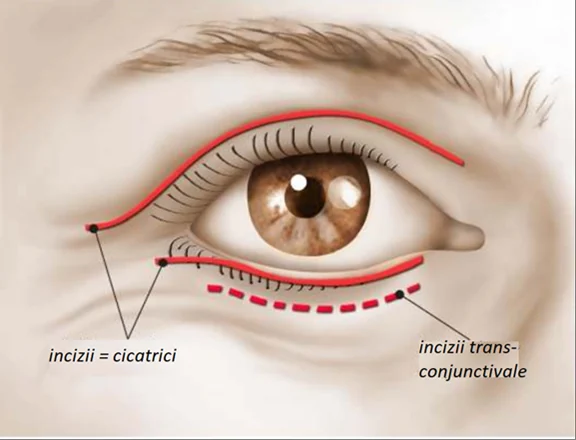
The incisions are placed so that the scars are as inconspicuous as possible:
Upper eyelid
- in the natural fold of the eyelid.
Lower eyelid
- immediately below the lash line;
- or on the inside of the eyelid (transconjunctival approach), when there are only fat pads without excess skin.
During the procedure it is possible to:
- remove the fat pads;
- excise the excess skin;
- reshape the tissues;
- carry out associated procedures (canthopexy, lipofilling, etc.) when necessary.
The procedure lasts approximately 30 minutes to 2 hours, depending on its complexity.
Anaesthesia
The procedure may be carried out:
- under local anaesthesia;
- under local anaesthesia with intravenous sedation;
- under general anaesthesia.
The type of anaesthesia is decided together with the surgeon and the anaesthetist.
Recovery
It is normal to experience:
- swelling;
- bruising;
- watering of the eyes;
- a feeling of tightness;
- slight ocular discomfort;
- temporarily slightly blurred vision.
In the first days the following are recommended:
- rest;
- avoiding physical effort;
- applying the prescribed treatment.
The stitches are usually removed between days 3-6.
Most patients resume their activity after approximately 6-20 days, depending on the extent of the procedure.
Risks and Limits
Possible imperfections
Occasionally the following may appear:
- small asymmetries;
- more visible scars;
- persistence of fine wrinkles;
- slight retraction of the lower eyelid.
If necessary, these can be corrected through a minor procedure after approximately 6 months.
Possible complications
Like any surgical procedure, blepharoplasty involves risks, although complications are rare.
These include:
- haematoma;
- infection;
- healing disorders;
- cysts at the level of the scars;
- dry eye or excessive watering;
- temporary difficulty in fully closing or opening the eyelids;
- ectropion (retraction of the lower eyelid), usually temporary;
- very rarely: double vision, glaucoma or severe visual disturbances.
The risks are reduced when the procedure is performed by an experienced plastic surgeon and when the post-operative recommendations are followed.
When Results Are Visible
The final result is assessed after approximately 3-6 months, when the swelling has completely disappeared and the scars have matured.
Blepharoplasty provides:
- a brighter look;
- a more rested appearance;
- reduction of excess skin;
- elimination of the fat pads.
The results are long-lasting and the fat pads rarely reappear. The natural ageing process nevertheless continues.
Conclusions
It is important to:
- follow all pre- and post-operative instructions;
- attend the scheduled follow-up appointments;
- contact the doctor immediately if intense pain, significant bleeding, changes in vision or signs of infection appear.
Blepharoplasty aims to achieve a natural and harmonious appearance of the eyes, preserving the normal function of the eyelids, with a high degree of satisfaction when the indication and the expectations are realistic.