

Breast reduction
Reduction of breast volume and weight with reshaping and repositioning of the areolae.
What the Procedure Is
(Breast reduction surgery for breast hypertrophy)
Definition
Breast hypertrophy is the excessive development of breast volume in relation to the general build of the patient. In most cases, large breasts are also associated with sagging (breast ptosis) and with a certain degree of asymmetry.
Large breast volume can cause physical and functional discomfort, such as:
- pain in the neck, shoulders and back;
- difficulty taking part in sporting activities;
- discomfort when wearing certain clothes;
- irritation or problems in the inframammary fold.
Beyond the physical effects, breast hypertrophy can have an important psychological impact, affecting body image, self-confidence and personal comfort.
This procedure has both an aesthetic and a functional role, aiming to improve comfort and to harmonise the shape of the breasts.
Who It May Suit
It may be indicated for back and shoulder pain, irritation beneath the breasts, restricted activity or marked disproportion.
What It Can and Cannot Address
The aim of breast reduction is:
- to reduce the volume of the breasts;
- to lift and reshape the breasts;
- to correct any asymmetries;
- to obtain breasts that are proportionate to the rest of the body;
- to improve physical and psychological comfort.
The objective is to obtain a natural and harmonious result, adapted to the build of the patient.
How the Consultation Works
Before the procedure
Before the operation the following are carried out:
- the surgical consultation;
- assessment of the shape and volume of the breasts;
- medical photographs;
- blood tests, depending on the case;
- pre-anaesthetic consultation;
- breast investigations (ultrasound and/or mammography, depending on age and indication).
It is important to inform the doctor about:
- treatments being followed;
- allergies;
- existing conditions;
- a history of coagulation problems.
Medication containing aspirin or non-steroidal anti-inflammatory drugs must not be used for approximately 10 days before the operation, unless recommended by the doctor.
In certain situations it may be necessary to stop oral contraceptives, particularly if there are risk factors for thrombosis.
Smoking and the surgical procedure
Smoking has a negative effect on healing and increases the risk of complications.
It may encourage:
- scarring problems;
- infections;
- skin damage;
- respiratory or cardiovascular complications during anaesthesia.
Complete cessation of smoking is recommended at least one month before the operation, continuing abstinence until healing is complete.
The same recommendations apply to electronic cigarettes.
How the Procedure Is Performed
Principle of the operation
The procedure consists of removing the excess breast tissue and skin.
The remaining breast tissue is reshaped, lifted and redistributed to create a more balanced breast shape.
In order for the skin to adapt to the new breast volume, the excess skin must be removed, which results in scars.
Depending on the volume of the breasts and the degree of sagging, the scars may have:
- the shape of an inverted T:
or
- a vertical shape, when the reduction required is smaller
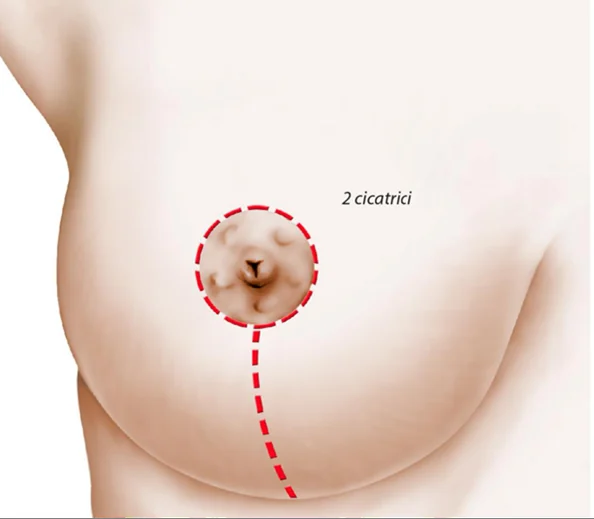
The scars are permanent, but over time they fade and become less visible.
The operation can be carried out once breast development is complete.
A subsequent pregnancy is possible. Breastfeeding may be preserved with certain surgical techniques, but it cannot be guaranteed in all situations.
The surgical procedure
The technique used is adapted to each patient.
During the operation:
- the excess breast tissue is removed;
- the remaining tissue is reshaped;
- the breast is lifted;
- the areola and nipple are repositioned if necessary;
- the skin is adapted to the new volume.
The removed tissues are sent for microscopic examination (histopathological examination).
Drainage tubes may sometimes be placed to evacuate fluid that accumulates after the operation. These are removed after a few days, depending on progress.
At the end of the operation a dressing is applied and wearing a special bra is recommended.
The procedure generally lasts between 2 and 4 hours, depending on the complexity of the case.
Anaesthesia
Type of anaesthesia and hospital stay
The anaesthesia
Breast reduction is generally performed under general anaesthesia.
The choice of anaesthetic method is made together with the anaesthetist, after assessment of the general state of health.
The hospital stay
A stay of approximately 1-2 days is usually necessary.
In certain situations, the procedure may be carried out with discharge on the same day, after a period of monitoring.
Recovery
After the operation - post-operative care
In the first days the following may appear:
- swelling of the breasts (oedema);
- bruising;
- a feeling of tightness;
- difficulty raising the arms.
Pain is usually moderate and can be controlled with painkillers.
The initial dressing is changed after approximately 24-48 hours.
The following are recommended:
- wearing the medical bra for approximately one month, day and night;
- avoiding intense physical effort;
- attending the medical follow-up appointments.
The sutures are usually absorbable or are removed as directed by the surgeon.
Returning to normal activities
The resumption of daily activities is gradual.
The length of recovery differs from one patient to another.
Demanding sporting activities must be avoided until healing is satisfactory.
Exposure of the scars to the sun must be avoided in order to prevent them becoming pigmented.
Risks and Limits
Possible imperfections of the result
There may be:
- small differences between the two breasts;
- differences in volume or position;
- scars that are more visible than desired;
- changes in the shape of the breast over time.
The scars fade progressively, but they do not disappear completely.
In certain situations, once the tissues have matured, a secondary surgical correction may be considered.
Possible complications
Breast reduction is a major surgical procedure and involves certain risks.
Complications related to anaesthesia
The anaesthetist will explain the specific risks before the operation.
Although rare, unpredictable individual reactions may occur.
Possible surgical complications
The following may appear:
- post-operative bleeding;
- a haematoma which may require evacuation;
- infection;
- delayed healing;
- partial opening of the sutures;
- necrosis of the skin, of the areola or of the breast tissue (rare);
- temporary or permanent changes in nipple sensitivity;
- hypertrophic or keloid scars;
- deep vein thrombosis or pulmonary embolism (rare).
Smoking significantly increases the risk of healing complications.
Choosing a qualified plastic surgeon and following the post-operative instructions reduce the risks, without eliminating them completely.
When Results Are Visible
The final result is assessed after approximately one year, when:
- the swelling has disappeared;
- the breasts have taken their final shape;
- the scars have matured.
In most cases the breasts become:
- smaller;
- higher;
- more proportionate;
- more harmonious with the figure.
The procedure can bring an important improvement in physical comfort, in clothing options and in psychological well-being.
The aim of the operation is improvement, not the attainment of perfection.