

Mastopexy (breast lift)
Lifting and reshaping of the breasts by repositioning tissue and the areola, with or without an implant.
What the Procedure Is
Breast ptosis is the descent of the breasts, accompanied by laxity and excess of the skin covering them. In this situation the breasts sit lower than normal and frequently show a loss of volume in the upper pole, giving them an "empty" appearance at the top.
Ptosis may be present from the time the breasts develop, but it most often appears after pregnancy and breastfeeding, or following significant weight loss. It may occur in isolation, a situation known as pure breast ptosis, or it may be associated with breast hypertrophy (excessively large breasts), in which case the volume can be reduced at the same time if the patient wishes.
Ptosis can also occur in patients with small breasts (breast hypoplasia or hypotrophy). In these situations, lifting the breasts may be combined with a volume-increasing procedure using breast implants or autologous fat transfer (lipofilling).
The aesthetic changes caused by breast ptosis can have a significant impact on body image and psychological well-being, which is why mastopexy has both an aesthetic and a reconstructive role.
Who It May Suit
It suits patients with breast ptosis after pregnancy, breastfeeding, weight loss or changes in skin elasticity.
What It Can and Cannot Address
The aim of mastopexy is to restore a harmonious position and shape to the breasts by:
- repositioning the areola-nipple complex at the appropriate anatomical level;
- reshaping and lifting the breast gland;
- removing excess skin;
- achieving breasts with a firm, proportionate and natural contour.
The procedure aims to improve the appearance of the breasts without altering the patient's bodily identity, restoring instead the proportions lost through the effect of gravity, pregnancies or major weight fluctuations.
How the Consultation Works
Consultation assesses the degree of ptosis, volume, asymmetry, skin quality, future pregnancy plans and whether an implant is appropriate.
How the Procedure Is Performed
Mastopexy consists of reshaping the breast by acting simultaneously on the breast gland and on the skin.
The breast gland is reshaped, concentrated and fixed in a higher position, and the excess skin is removed to allow the skin to adapt to the new volume and the new shape of the breast.
During the same operation, the areola-nipple complex is repositioned in a normal anatomical position.
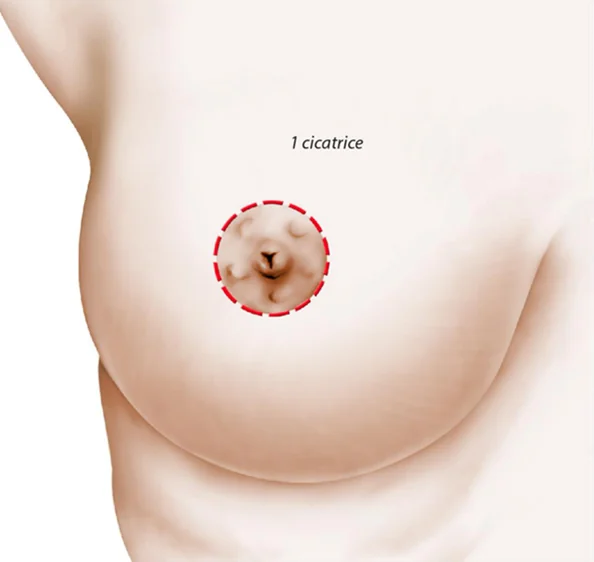
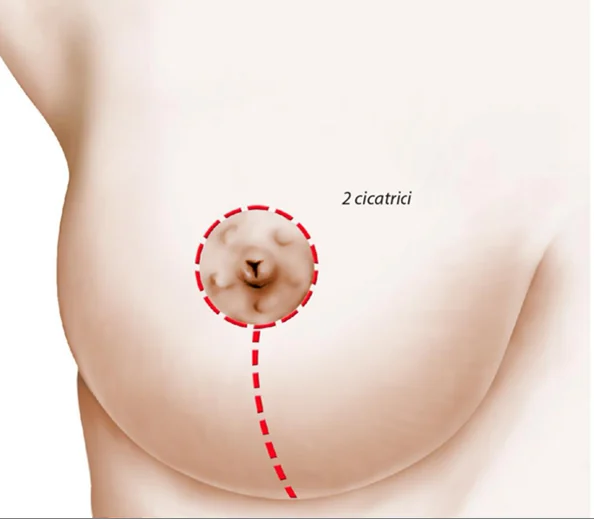
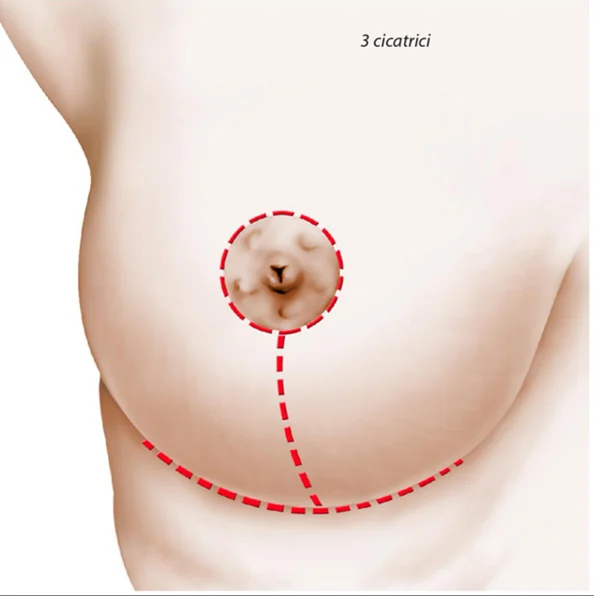
At the end of the operation the skin edges are sutured, resulting in scars whose extent depends on the degree of ptosis and on the technique used.
Types of scars
In the case of significant ptosis, the scar has the shape of an inverted T (anchor) and includes:
- a periareolar scar, located at the border between the areola and the surrounding skin;
- a vertical scar, between the lower edge of the areola and the inframammary fold;
- a horizontal scar, hidden in the inframammary fold.
The length of the horizontal component is directly proportional to the degree of ptosis.
In the case of moderate ptosis, the vertical technique may be used, which eliminates the scar in the inframammary fold and leaves only the periareolar and the vertical scar.
In situations where the ptosis is minimal, the correction can be achieved exclusively through a scar located around the areola.
Combining with breast augmentation
When ptosis is accompanied by insufficient breast volume, mastopexy may be combined, in the same operation, with:
- breast augmentation with implants;
- augmentation through autologous fat transfer (lipofilling).
In these cases the amount of skin excised is often smaller and the scars may be shorter.
Mastopexy can be performed once breast development is complete.
A subsequent pregnancy is possible after this procedure. In most cases breastfeeding remains possible, but this cannot be guaranteed, as there is a small risk that the ability to breastfeed may be affected, depending on the surgical technique used.
The procedure does not increase the risk of developing breast cancer.
Anaesthesia
The operation is performed under general anaesthesia.
Recovery
A surgical bra is worn, lifting and strenuous arm activity are restricted, and follow-up monitors scar healing.
Risks and Limits
Risks include bleeding, infection, asymmetry, sensory changes, healing problems, rare areolar necrosis and unfavourable scars.
When Results Are Visible
The initial shape settles progressively over several months. Scars fade with time but do not disappear completely.