

Breast Augmentation
Procedure to increase and, where relevant, reshape breast volume using breast implants.
What the Procedure Is
Breast augmentation is the surgical procedure through which the volume of the breasts is increased and their shape improved using breast implants.
The procedure is indicated for women who wish to have:
- fuller and more harmonious breasts;
- correction of breast asymmetries;
- restoration of volume lost after pregnancy, breastfeeding or weight loss;
- improved body proportions and greater self-confidence.
When there is also significant excess skin or sagging breasts (breast ptosis), augmentation may be combined with mastopexy (breast lift).
Who It May Suit
It may suit patients who want increased breast volume, improved symmetry, or restored volume lost, for example, after pregnancy or breastfeeding.
What It Can and Cannot Address
Breast augmentation can increase volume and improve breast symmetry. It does not prevent the natural effects of ageing or of future pregnancies, and it does not replace a mastopexy (lift) when significant sagging is present.
How the Consultation Works
The pre-operative consultation
Every patient has a different anatomy and different goals. During the consultation the following are assessed:
- the shape and size of the breasts;
- the quality of the skin and tissues;
- breast symmetry;
- the width of the chest;
- the patient's lifestyle and wishes.
Together we choose the appropriate implant so that the result is proportionate, natural and adapted to each person.
Before the operation
Before the procedure the following are required:
- blood tests;
- pre-anaesthetic consultation;
- ultrasound or mammography, when indicated.
To reduce the risk of complications it is recommended to:
- stop smoking at least 4 weeks before and after the procedure;
- avoid medication containing aspirin or anti-inflammatory drugs, as directed by the doctor;
- fast before the operation, according to the anaesthetist's recommendations.
How the Procedure Is Performed
Choosing the implants
There are many types of implants, differentiated by:
- volume;
- shape (round or anatomical);
- profile;
- surface.
In our practice we use modern, CE-certified, high-quality breast implants, the choice being individualised according to the anatomy and the aesthetic goals of each patient.
How the procedure is carried out
The operation is performed under general anaesthesia and lasts, on average, between 1 and 2 hours.
The implants can be inserted through one of the following incisions:
- in the inframammary fold;
- around the areola;
- in the armpit (in selected cases).
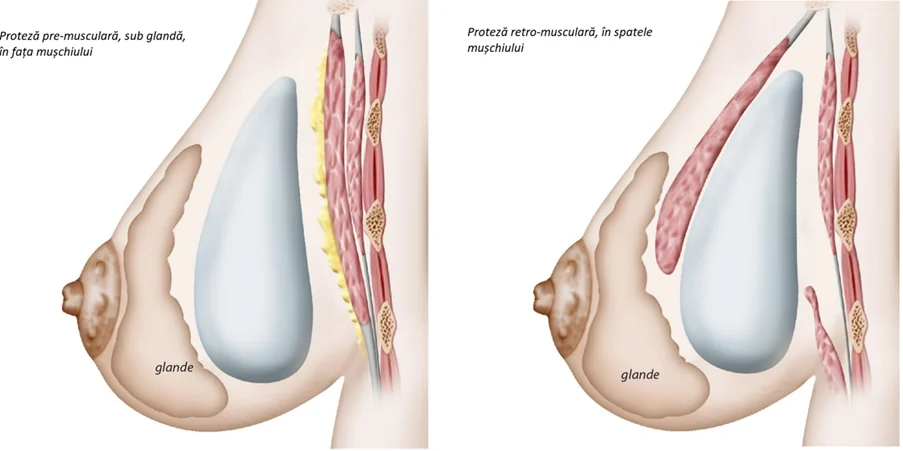
Depending on the anatomical particularities, the implant may be positioned:
- under the gland;
- under the muscle;
- in a dual plane (Dual Plane), one of the most widely used modern techniques.
The decision is made together with the patient following the consultation.
Breast implants
Modern breast implants are safe and durable medical devices, but they are not considered permanent.
They require periodic monitoring and, in certain situations, may need to be replaced over the course of a lifetime.
Regular consultations and the imaging investigations recommended by the doctor make it possible to assess the integrity of the implants and to maintain an optimal result.
Anaesthesia
The type of anaesthesia used is determined by the medical team based on the complexity of the case. [TO BE CONFIRMED: the clinic standard anaesthesia protocol for this procedure]
Recovery
In the first days it is normal to experience:
- a feeling of tightness in the breasts;
- swelling;
- bruising;
- discomfort when moving the arms.
Most patients:
- return to light activities in approximately 5-10 days;
- wear the compression bra for 4-6 weeks;
- resume sporting activity progressively after 6-8 weeks.
The result continues to refine itself over the first months, as the implants settle and the tissues adapt.
Risks and Limits
Like any surgical procedure, breast augmentation involves certain risks, even if these are rare when the operation is carried out under safe conditions.
Complications may include:
- haematoma;
- seroma;
- infection;
- changes in sensitivity;
- unfavourable scarring;
- capsular contracture;
- displacement or rotation of the implant;
- rupture of the implant over time.
These risks are discussed in detail during the consultation and in the informed consent.
When Results Are Visible
The final result can be assessed after approximately 2-3 months.
The aim of the procedure is to obtain harmonious breasts, proportionate to the figure and as natural as possible both visually and to the touch.
The shape of the breasts will continue to change over time, like any natural tissue, under the influence of the ageing process, weight fluctuations and pregnancies.
FAQ About This Procedure
Can I breastfeed after breast augmentation?
In most cases, yes. Implants do not prevent breastfeeding.
Do implants increase the risk of breast cancer?
There is no evidence that breast implants increase the risk of breast cancer. Breast screening nevertheless remains essential and must be carried out according to the doctor's recommendations.
How long do implants last?
Current implants do not have a fixed expiry date, but they require periodic monitoring. They are replaced only if clinical or imaging changes appear, or if the patient wishes it.
When can I return to work?
Generally after 5-10 days, depending on the type of activity carried out.