

Brow Lift
The brow lift is an aesthetic surgical procedure whose aim is to reposition eyebrows that have descended, by removing a small amount of skin located above them.
What the Procedure Is
The brow lift is an aesthetic surgical procedure whose aim is to reposition eyebrows that have descended, by removing a small amount of skin located above them, leaving a scar that is as discreet as possible.
The descent of the eyebrows (brow ptosis) may be caused by hereditary factors or, most frequently, by the natural ageing process, through the loss of skin elasticity and a change in the balance between the muscles that raise and those that lower the eyebrow.
This procedure is intended to improve the appearance of the periocular area and not to alter the natural features of the face.
What It Can and Cannot Address
The aim of the procedure is:
- to lift the eyebrow, particularly its outer portion (the tail of the eyebrow);
- to correct a tired or heavy-looking gaze;
- to restore a harmonious distance between the eyebrow and the upper eyelid;
- to obtain a more open and balanced appearance of the eyes.
The procedure aims to bring the anatomical structures back to a position closer to the one they had before the ageing process.
How the Consultation Works
During the pre-operative consultation the following are carried out:
- assessment of the shape and position of the eyebrows;
- examination of the eyelids and of the periocular area;
- analysis of the quality of the skin and of any existing scars;
- assessment of the patient's wishes and determination of the appropriate technique.
When it is combined with blepharoplasty, an ophthalmological consultation may be recommended.
The anaesthetist will carry out an assessment before the procedure.
It is necessary to:
- avoid medication containing aspirin for 10 days before the operation;
- follow the instructions regarding food before the procedure, according to the type of anaesthesia.
How the Procedure Is Performed
Principles
With age, the eyebrow tends to descend, particularly on the outer side, which can accentuate the excess skin at the level of the upper eyelid and the tired appearance of the eyes.
The brow lift makes it possible to reposition the eyebrow by removing a segment of skin located immediately above it.
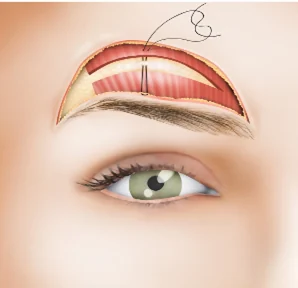
The procedure does not aim to fully correct the excess skin on the upper eyelid. An upper blepharoplasty may be necessary for that problem.
The brow lift may be combined with:
- upper blepharoplasty;
- lipostructure (injection of the patient's own fat to restore lost volume);
- other facial rejuvenation procedures.
The alternatives may include:
- the temporal lift;
- botulinum toxin treatments to change the muscular balance;
- hyaluronic acid injections for a discreet lift of the tail of the eyebrow.
The procedure
The surgical technique is adapted to each case.
The general principles are:
- assessing the degree of descent of the eyebrow;
- determining the amount of skin that must be removed;
- making an incision as close as possible to the upper edge of the eyebrow in order to camouflage the scar;
- removing the excess skin;
- careful suturing to obtain a scar that is as fine as possible.
A different technique, such as the temporal lift, may sometimes be necessary, depending on the anatomical particularities.
The length of the procedure varies according to the technique used and to any associated procedures.
Anaesthesia
The brow lift may be carried out under:
- simple local anaesthesia;
- local anaesthesia combined with intravenous sedation;
- general anaesthesia.
The choice of method is made together with the surgeon and the anaesthetist.
The procedure is usually carried out as day surgery, with discharge on the same day after a period of observation.
Recovery
After the procedure the following may appear:
- a feeling of tightness above the eyebrows;
- swelling (oedema);
- bruising;
- a slightly over-elevated position of the eyebrow, temporarily.
These are normal and reduce progressively.
Recommendations:
- avoiding intense physical effort in the first days;
- following the prescribed treatment;
- protecting the scars from sun exposure.
The sutures are usually removed between day 7 and day 10 after the procedure.
The return to usual activities is rapid, depending on the progress of each patient.
Risks and Limits
Possible imperfections of the result
The following may appear:
- small asymmetries between the eyebrows;
- scars that are more visible than anticipated;
- insufficient or excessive correction;
- persistence of excess skin on the upper eyelid, a situation which may require blepharoplasty.
Any secondary corrections are usually considered at least 6 months after the initial procedure.
Possible complications
The brow lift is a surgical procedure and involves certain risks, even if these are rare.
The possible complications include:
- haematomas which may require evacuation;
- local infections, which are rare;
- difficult healing or unsightly scars;
- hypertrophic or keloid scars;
- epidermal cysts along the scar;
- temporary or, rarely, permanent loss of sensitivity above the eyebrow;
- localised hair loss in the area of the scar;
- temporary impairment of the mobility of the frontalis muscle.
The anaesthetic risks will be explained by the anaesthetist before the procedure.
Choosing a qualified plastic surgeon and following the post-operative recommendations help to reduce the risks and to obtain an optimal result.
When Results Are Visible
The result begins to be appreciated after a few weeks, but the final assessment is made between 1 and 6 months after the procedure.
Complete healing of the scars may take approximately one year.
The procedure makes it possible to:
- open up the eyes;
- reduce the tired appearance of the face;
- reposition the eyebrows in a more harmonious position.
The result is long-lasting, but the natural ageing process continues and may in time cause the eyebrows to descend again.
Conclusions
The brow lift is a procedure intended to improve the appearance of the upper area of the face, by repositioning the eyebrows and restoring a more open and harmonious look to the eyes.
The objective is to achieve a natural improvement, not to change the facial expression or to attain absolute perfection.